








In the United States, certain foods carry the weight of a place so completely that eating them feels like stepping across a county line. They are not the dishes that dominate Instagram feeds or spawn nationwide franchise menus. Instead, they live quietly in church basements, at family reunions, and in the recipe boxes of grandmothers who never measured a thing but somehow got it perfect every time.
The Indiana Sugar Cream Pie is one of these quiet treasures.
In the eastern farmlands of the Hoosier State, this pie is not a novelty. It is a fact of life. In 2009, the Indiana legislature designated it the official state pie,a rare moment of political unity that tells you everything you need to know about its cultural standing. No one argued. No one debated. When it comes to sugar cream pie, Hoosiers simply nod. They know.
A pie born from necessity, perfected by time
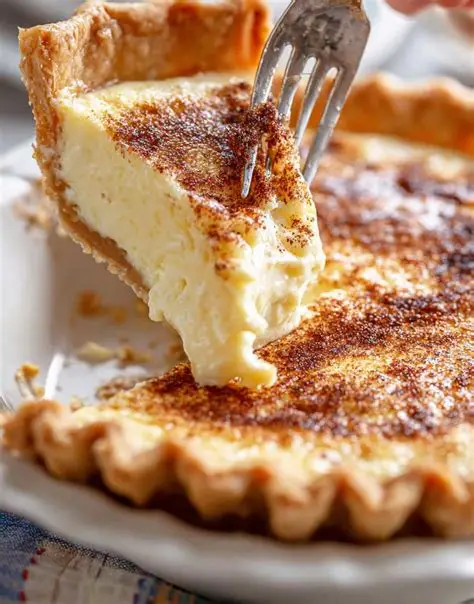
If you approach a sugar cream pie expecting the architectural drama of a lattice top cherry or the towering meringue of a lemon cloud, you will be underwhelmed. This pie is deliberately, almost stubbornly, plain. A single crust holds a filling made from little more than sugar, cream, flour, butter, and a whisper of vanilla. There is no fruit. No chocolate. No caramel drizzle. Just a pale, smooth custard that wobbles ever so slightly when the pie plate is set on the table.
Its origins trace back to Indiana’s Amish and Shaker communities, where resourcefulness was not a trend but a necessity. Fresh fruit was seasonal. Chocolate was a luxury. But sugar, cream, and flour. These were pantry constants. The pie emerged from what was available, and in doing so, it became something greater than the sum of its humble parts.
The texture is the first quiet surprise. The filling sets into a silky, almost pudding, like consistency firm enough to slice cleanly, yet soft enough to melt against the roof of your mouth. The top develops a delicate, golden brown skin during baking, dusted with a whisper of nutmeg that perfumes each bite without announcing itself loudly.
A first bite that asks for patience
Sugar cream pie does not shout. It does not assault the palate with acidity or bitterness or the sharp bite of spice. The first forkful lands gently creamy, sweet, and warm, with a buttery crust that crumbles just enough to remind you that someone’s hands pressed it into the pan.
By the second or third bite, something shifts. You begin to notice the balance. The sweetness is present but never cloying. The cream coats the tongue without heaviness. The nutmeg lingers just behind the vanilla, a ghost of warmth that keeps you reaching for the next forkful before you have fully finished the last.
And then, without ceremony, the slice is gone. The plate sits empty. You feel full but not weighed down. Satisfied but not overwhelmed. This is the quiet genius of sugar cream pie: it leaves you wanting nothing, yet missing it already.
A pie that belongs to everyone
Across Indiana, sugar cream pie appears wherever people gather. It cools on windowsills during county fairs. It sits between the green bean casserole and the ham at funeral dinners. It is sliced and served at fish fries, at tractor shows, and in the cramped kitchens of diners that have been open since before the interstate highway system existed.
There is no single “correct” recipe. Some families add a touch more vanilla. Some swear by a dash of cinnamon alongside the nutmeg. A few old timers insist on a tablespoon of cornstarch for a firmer set, while purists reject anything beyond flour as a thickening agent. These small variations do not divide people. They simply mark whose grandmother’s pie you are eating.
The pie does not belong to chefs or restaurants. It belongs to the home baker who wakes early to roll out dough before the kitchen warms up. It belongs to the Amish woman selling whole pies from a roadside stand with a handwritten sign. It belongs to Indiana.
A dessert that does not travel well and that is the point
Sugar cream pie has never gone national in any meaningful way. You will not find it in the freezer aisle of a supermarket in California. You will not see it featured on a cooking competition show. And perhaps that is exactly as it should be.
Some foods are meant to stay close to home. They are tied to the soil, the seasons, and the people who have been making them for so long that the recipe lives in their hands, not on a card. Sugar cream pie is one of these foods. It resists export. It does not scale. It is best eaten in a kitchen that smells faintly of nutmeg and butter, while someone asks if you would like a second piece before you have even finished the first.
If you find yourself driving through Indiana, past the cornfields, past the silos, past the small towns with names like Nappanee and Shipshewana, pull over when you see a handwritten sign that says “Pies.” Order the sugar cream. Eat it slowly. Let it be exactly what it is.